> ## Documentation Index
> Fetch the complete documentation index at: https://docs.train.tech/llms.txt
> Use this file to discover all available pages before exploring further.
# Original HTLC
> Introduction to original Atomic Swaps and their challenges
Atomic Swaps (HTLC - Hashed Time Lock Contract) enable peer-to-peer asset exchange without requiring one Network to know the state of the other. The User generates a secret and locks funds on the Source Network. Then, the Solver locks funds on the Destination Network. They exchange the secret to unlock their respective funds, with a time limit ensuring fund retrieval if the exchange fails.
### The Standard HTLC Flow
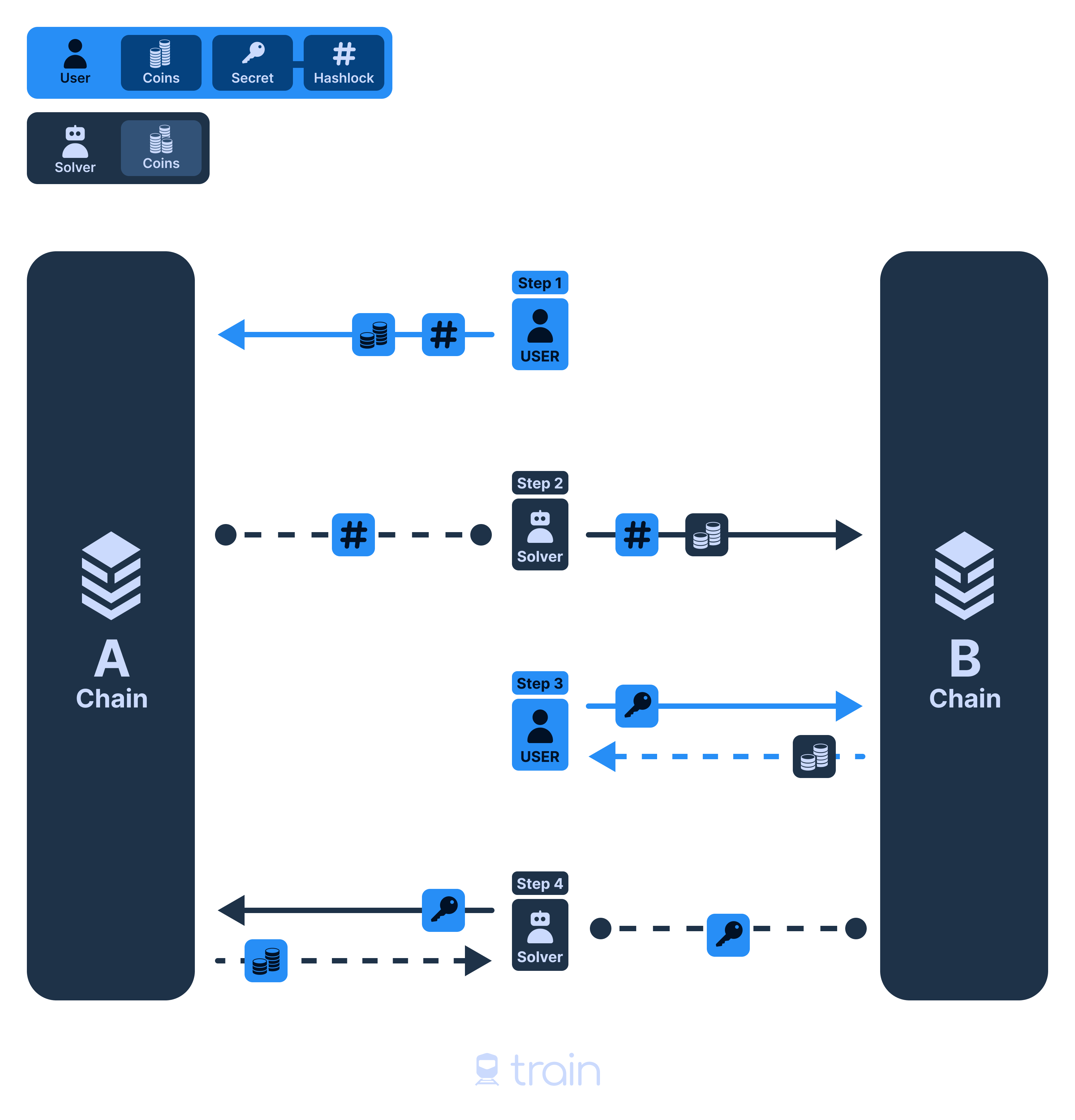 The User generates a *Secret* S and computes *Hashlock* HASH(S). Then, they create an HTLC, locking funds for the selected Solver in the Source Network.
The Solver detects this HTLC and creates a counterparty HTLC with the same Hashlock. This locks funds for the User (initial amount minus the *Solver Fee*) in the Destination Network.
The User detects the HTLC in the Destination Network and reveals S to claim the funds.
The Solver detects the revealed S and reveals it in the Source Network to claim their funds.
### Challenges with HTLCs
Despite their potential, HTLCs have proven impractical for real-world bridging due to three main issues:
* **Secret Management**: Users must generate and securely manage a Secret until the counterparty completes their transaction.
* **Liveness**: Users must maintain the state of the bridging process locally and actively monitor and respond to counterparty transactions.
These challenges significantly impact the User experience and create barriers to adoption. The requirement for Users to manage the Secret creates a dependency issue. If the User closes the browser, clears the cache, or loses access to the Secret, the transaction flow cannot be recovered from the chain data.
The User generates a *Secret* S and computes *Hashlock* HASH(S). Then, they create an HTLC, locking funds for the selected Solver in the Source Network.
The Solver detects this HTLC and creates a counterparty HTLC with the same Hashlock. This locks funds for the User (initial amount minus the *Solver Fee*) in the Destination Network.
The User detects the HTLC in the Destination Network and reveals S to claim the funds.
The Solver detects the revealed S and reveals it in the Source Network to claim their funds.
### Challenges with HTLCs
Despite their potential, HTLCs have proven impractical for real-world bridging due to three main issues:
* **Secret Management**: Users must generate and securely manage a Secret until the counterparty completes their transaction.
* **Liveness**: Users must maintain the state of the bridging process locally and actively monitor and respond to counterparty transactions.
These challenges significantly impact the User experience and create barriers to adoption. The requirement for Users to manage the Secret creates a dependency issue. If the User closes the browser, clears the cache, or loses access to the Secret, the transaction flow cannot be recovered from the chain data.